the Comet from Christian Stangl on Vimeo.
"In 2016 an exciting mission was ended.
The Rosetta spacecraft made its final manouver. A controlled hard-landing on the comet Churyumov-Gerasimenko (67p).
Before that Rosetta accompanied the Comet for more then 2 years. It
researched valuable scientific data, brought a lander on to the comets
surface and took a vast number of pictures.
2017 Esa released over 400000 images from Rosettas comet mission.
Based on these material Motion Designer Christian Stangl and Composer Wolfgang Stangl worked together to create this shortfilm.
The sequences are digitally enhanced real-footage from the probe."

Showing posts with label space. Show all posts
Showing posts with label space. Show all posts
Thursday, September 19, 2019

Thursday, July 18, 2019
Apollo 11 Moon Launch 50th Anniversary | CBS News Special Coverage, live stream
Friday, April 18, 2014
Star Talk with Neil deGrasse Tyson
Season 5, Episode 11

"Red pill or blue pill? You get both when Neil deGrasse Tyson interviews Morpheus himself, actor Laurence Fishburne. They sat down while Neil was in New Mexico filming COSMOS and Laurence was filming The Signal, a new indie sci-fi film. You’ll get a healthy dose of reality, as they talk about Fishburne’s roles in The Matrix, Searching for Bobby Fischer, and CSI. And you’ll dive into the world of the imagination as the two sci-fi fans discuss why style can be more important than substance in sci-fi and geek out over Star Trek, Superman and Watchmen. They also talk about chess, science vs. religion, planetariums and using math and science to explore the world. Laurence tells Neil how and why he became an actor at age 10, and discusses his future plans to produce, direct, write plays and return to Broadway. You’ll also find out what role Laurence wanted to play but didn’t, and why he got the key to the city of Cambridge." (via StarTalkRadio)
Thursday, April 17, 2014
How do we know the Earth goes about the sun?

Image: NASA. A view of the sunrise (and moon) as seen from the ISS captured by astronaut Karen Nyberg
"The first big problem with the geocentric model was the retrograde motion of planets like Mars. If you looked at the location of Mars each night, it might sometimes do this."

(Read the rest at Wired)
Monday, April 14, 2014
Wednesday, March 26, 2014
Web Nuggets 4

How Ancient Alexandria Became an Intellectual Center - Wired Science
"They had to start from scratch. Alexandria was a brand-new city with a population consisting most of soldiers and sailors of the Ptolemies’ armed forces, bureaucrats and clerks of their administration, and the mixed bag of traders, businessmen, craftsman [sic], swindlers, and whatnot, who see opportunity in, as it were, a fresh playing field. Intellectuals had to be blandished into coming to a place that to all outward appearances was a cultural wasteland."
Can't find a time machine to go back to Ancient Alexandria? Looking for something closer to home to read? Check out openlibrary.org
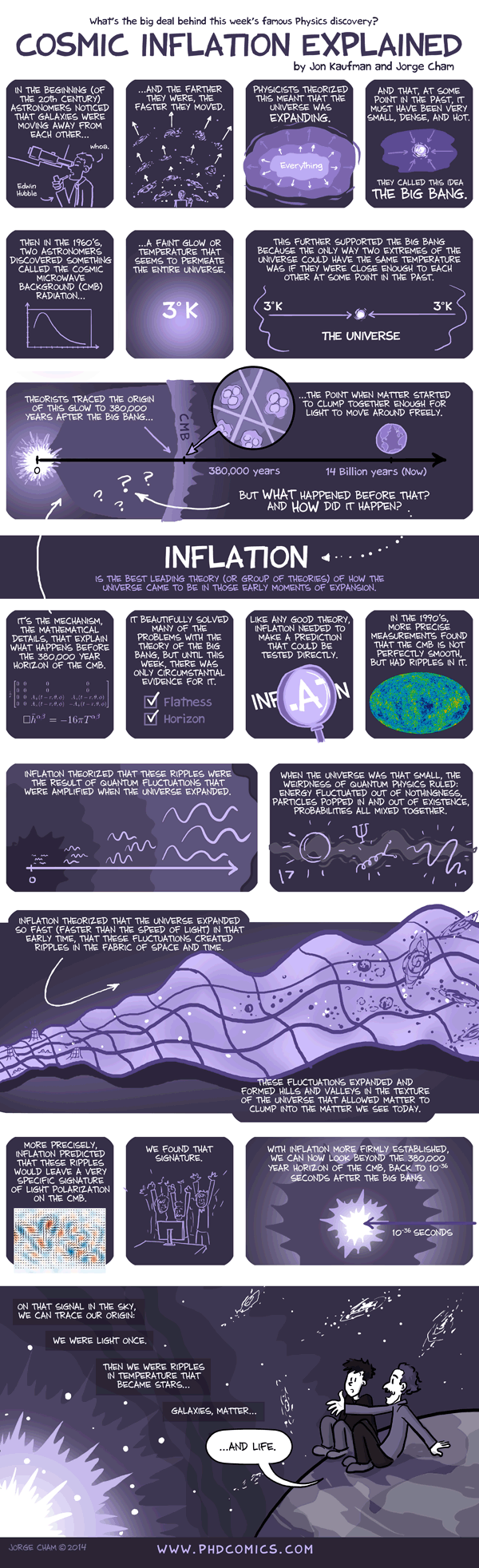
Gravitational Waves and Inflation explained by PHD comics.
A few posts on Art.
The Guardian had an article titled "The 10 Greatest works of art ever". Pretty tough list to put together. Though I do enjoy this one:
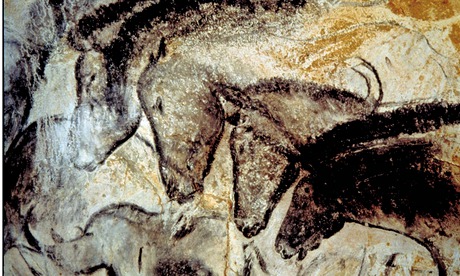
(Chauvet Cave Paintins (c 30,000 years ago)
BoingBoing.net had this great picture of some London Street Art.

(photo: Jason Weisberger)
Huffington Post had an article on 'The Gorgeous History of Tattoos, From 1900 to Present".

"The mind is an endless train weaving its way through the landscape of reality.
But who made the train tracks and where is the conductor?”
From the book ‘Sex, Drugs, Einstein, and Elves: Sushi, Psychedelics, Parallel Universes, and the Quest for Transcendence’ by Clifford A. Pickover
Friday, January 31, 2014
Web Nuggets 1

Some of the interesting articles I have bumped up against while surfing the information superhighway...
“The remains of a bustling port and barracks for sailors or military troops have been discovered near the Giza Pyramids. They were in use while the pyramids were being built about 4,500 years ago.”
(found via grahamhancock.com)
“NASA is planning missions to demonstrate how to make water on the moon and oxygen on Mars.”
(via grahamhancock.com)
20 Year Old Hunter S. Thompson’s Superb Advice on How to Find Your Purpose and Live a Meaningful Life - Brainpickings.org
“It is not necessary to accept the choices handed down to you by life as you know it.”
(via disinfo.com)
“Should we ever detect an extraterrestrial civilization, or any kind of alien life for that matter, it's a safe bet they'll look very different from us. They'll also probably think in a way that's completely foreign to what we're used to. Here's how experts believe we might be able to predict what the minds of aliens will be like."
Saturday, December 14, 2013
Sun Gazing 101
Super Human Abilities Confirmed by NASA...
The Internet often can have some way out there concepts, ideas, conspiracies, which all have their place in the human story. But this is one of the most intriguing ideas I've come across in a while. The idea is that instead of getting our nutrition from the "normal" way we can get all we need from "Sun gazing (also known as sun-eating) [which] is the strict practice of gradually introducing sunlight into your eyes at the lowest ultraviolet-index times of day – sunrise and sunset."
Read on at the link above or watch the documentaries below and start staring at the sun.

The Internet often can have some way out there concepts, ideas, conspiracies, which all have their place in the human story. But this is one of the most intriguing ideas I've come across in a while. The idea is that instead of getting our nutrition from the "normal" way we can get all we need from "Sun gazing (also known as sun-eating) [which] is the strict practice of gradually introducing sunlight into your eyes at the lowest ultraviolet-index times of day – sunrise and sunset."
Read on at the link above or watch the documentaries below and start staring at the sun.

Wednesday, December 4, 2013
The overview effect... Awesome!
"On the 40th anniversary of the famous ‘Blue Marble’ photograph taken of
Earth from space, Planetary Collective presents a short film documenting
astronauts’ life-changing stories of seeing the Earth from the outside –
a perspective-altering experience often described as the Overview
Effect."
Thanks 2E for bringing this to my attention. Coob.
OVERVIEW from Planetary Collective on Vimeo.
Thanks 2E for bringing this to my attention. Coob.
Finding planets
Nasa's Hubble telescope finds signs of water of five distant planets.
(via the Independent)
"Nasa has reported that “faint signatures of water” have been found in the atmospheres of five planets outside our solar system, marking a further development in the search for planets capable of supporting alien life." read the rest
Alien Super-Earths Plentiful in Exoplanet Search.
(via space.com)

"Observations using space-based and ground-based telescopes have indicated that a new class of objects dubbed super-Earths – worlds that are about two to 10 times our planet's mass and up to two times its radius – could be among the most common type of planets orbiting other stars." read the rest
Wednesday, November 20, 2013
Inner Space and quantum Space
NASA gets itself a quantum computer. What are their plans?
 "According to physicist David Deutsch, a quantum system can work on a
million computations at once while a standard desktop PC works on just
one. Put another way, a 30-qubit system would be equal in processing
power to a traditional 10 teraflop machine, which crunches trillions of
operations each second.
"According to physicist David Deutsch, a quantum system can work on a
million computations at once while a standard desktop PC works on just
one. Put another way, a 30-qubit system would be equal in processing
power to a traditional 10 teraflop machine, which crunches trillions of
operations each second.
These computers will help us find the most expedient solution to a complex problem. As such, they're poised to revolutionize the way we go about data analysis and optimization — including such realms as air traffic control, courier routing, protein modeling, weather prediction, database querying, and hacking tough encryption schemes."
Read the rest.
(via IO9)
A Neuroscientist's Radical Theory of How Networks become Consciousness
 "It’s a question that’s perplexed philosophers for centuries and
scientists for decades: Where does consciousness come from? We know it
exists, at least in ourselves. But how it arises from chemistry and
electricity in our brains is an unsolved mystery.
"It’s a question that’s perplexed philosophers for centuries and
scientists for decades: Where does consciousness come from? We know it
exists, at least in ourselves. But how it arises from chemistry and
electricity in our brains is an unsolved mystery.
Neuroscientist Christof Koch, chief scientific officer at the Allen Institute for Brain Science, thinks he might know the answer. According to Koch, consciousness arises within any sufficiently complex, information-processing system. All animals, from humans on down to earthworms, are conscious; even the internet could be. That’s just the way the universe works."
Read the rest on Wired.com
(via Grahamhancock.com)

These computers will help us find the most expedient solution to a complex problem. As such, they're poised to revolutionize the way we go about data analysis and optimization — including such realms as air traffic control, courier routing, protein modeling, weather prediction, database querying, and hacking tough encryption schemes."
Read the rest.
(via IO9)
A Neuroscientist's Radical Theory of How Networks become Consciousness

Neuroscientist Christof Koch, chief scientific officer at the Allen Institute for Brain Science, thinks he might know the answer. According to Koch, consciousness arises within any sufficiently complex, information-processing system. All animals, from humans on down to earthworms, are conscious; even the internet could be. That’s just the way the universe works."
Read the rest on Wired.com
(via Grahamhancock.com)
Tuesday, October 29, 2013
Thursday, September 19, 2013
something large, something small, and something else
Something rather large and mind boggling:
via (deepastronomy.com)
Something rather small and mind boggling:
 "Physicists have discovered a jewel-like geometric object that
dramatically simplifies calculations of particle interactions and
challenges the notion that space and time are fundamental components of
reality..."
"Physicists have discovered a jewel-like geometric object that
dramatically simplifies calculations of particle interactions and
challenges the notion that space and time are fundamental components of
reality..."
"...The amplituhedron looks like an intricate, multifaceted jewel in higher dimensions. Encoded in its volume are the most basic features of reality that can be calculated, “scattering amplitudes,” which represent the likelihood that a certain set of particles will turn into certain other particles upon colliding. These numbers are what particle physicists calculate and test to high precision at particle accelerators like the Large Hadron Collider in Switzerland."
Read more.
Which kind of made me think of Inra's net.
 "Francis Harold Cook describes the metaphor of Indra's net from the perspective of the Huayan school in the book Hua-Yen Buddhism: The Jewel Net of Indra:
Far away in the heavenly abode of the great god Indra, there is a wonderful net which has been hung by some cunning artificer in such a manner that it stretches out infinitely in all directions. In accordance with the extravagant tastes of deities, the artificer has hung a single glittering jewel in each "eye" of the net, and since the net itself is infinite in dimension, the jewels are infinite in number. There hang the jewels, glittering "like" stars in the first magnitude, a wonderful sight to behold. If we now arbitrarily select one of these jewels for inspection and look closely at it, we will discover that in its polished surface there are reflected all the other jewels in the net, infinite in number. Not only that, but each of the jewels reflected in this one jewel is also reflecting all the other jewels, so that there is an infinite reflecting process occurring." (via wikipedia).
via (deepastronomy.com)
Something rather small and mind boggling:
A Jewel at the Heart of Quantum Physics
"...The amplituhedron looks like an intricate, multifaceted jewel in higher dimensions. Encoded in its volume are the most basic features of reality that can be calculated, “scattering amplitudes,” which represent the likelihood that a certain set of particles will turn into certain other particles upon colliding. These numbers are what particle physicists calculate and test to high precision at particle accelerators like the Large Hadron Collider in Switzerland."
Read more.
Which kind of made me think of Inra's net.

Far away in the heavenly abode of the great god Indra, there is a wonderful net which has been hung by some cunning artificer in such a manner that it stretches out infinitely in all directions. In accordance with the extravagant tastes of deities, the artificer has hung a single glittering jewel in each "eye" of the net, and since the net itself is infinite in dimension, the jewels are infinite in number. There hang the jewels, glittering "like" stars in the first magnitude, a wonderful sight to behold. If we now arbitrarily select one of these jewels for inspection and look closely at it, we will discover that in its polished surface there are reflected all the other jewels in the net, infinite in number. Not only that, but each of the jewels reflected in this one jewel is also reflecting all the other jewels, so that there is an infinite reflecting process occurring." (via wikipedia).
Thursday, August 22, 2013
91 Centimeters
This is a short animated film that I watched this morning. At first my thoughts about what the movie meant ran towards whether or not the individual is the center of his or her own universe; that is, did the meteorite knock the man, Henry, out of his world by 91 centimeters or did it knock the world 91 centimeters away from him. Of course, when I contemplated the role of the psychologist/psychiatrist in the overall narrative, I began to see the movie as a parable for some sort of sudden onset mental illness that Henry is dealing with all alone; thus the relative or I guess absolute indifference of everyone around him.
What do you think?
What do you think?
Thursday, June 13, 2013
Subscribe to:
Posts (Atom)